Most homeowners we speak with in the Lake Lanier area ask the same question eventually.
“How often do I really need to clean to keep this place sanitary?”
We hear you.
Between commute times down I-985 and managing family schedules, finding the balance is tough.
You don’t want to spend your entire weekend scrubbing floors.
But you also want to know your home is safe and welcoming.
The answer isn’t about cleaning more.
It is about cleaning smarter based on traffic patterns and biology.
We have spent 15 years refining a schedule that prioritizes hygiene without taking over your life.
Let’s break down exactly what needs attention and when.
Kitchen: The High-Traffic Zone
Your kitchen is the operational hub of the house.
Studies from organizations like NSF International consistently rank kitchen sinks and sponges as germier than most bathroom surfaces.
We see this firsthand in homes across Buford and Gainesville.
Food prep creates organic waste that bacteria love.
This room requires the most frequent intervention to prevent cross-contamination.
The “Triangle of Grime” Strategy
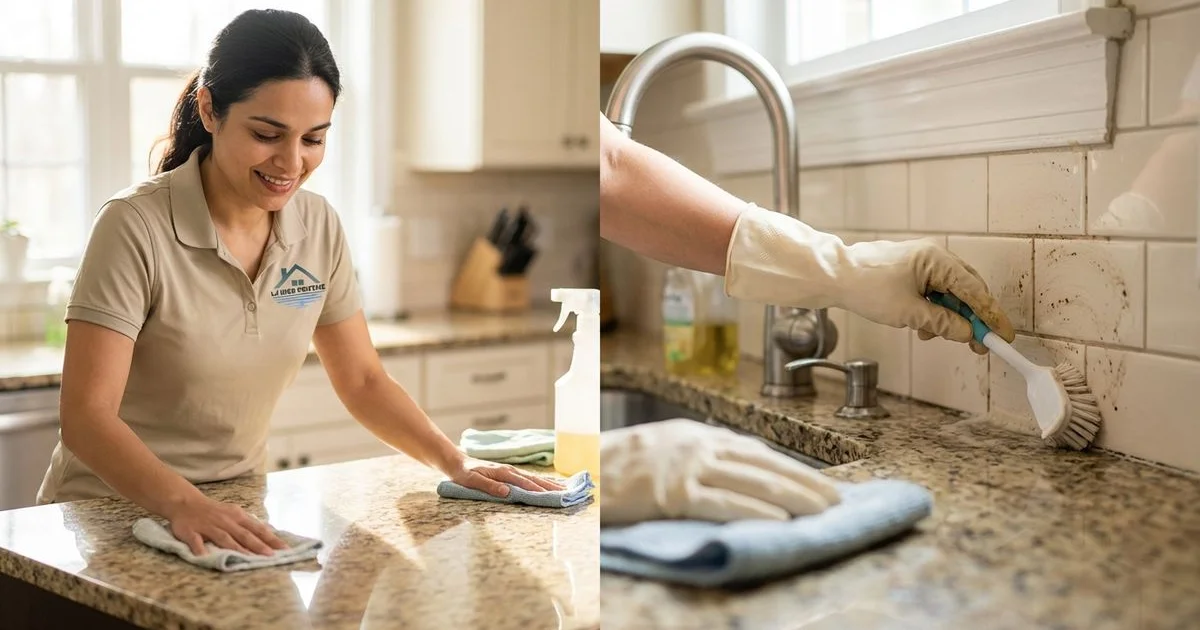
We focus our daily efforts on the three spots that collect the most bacteria: the sink, the refrigerator handle, and the stove knobs.
A quick wipe of these three areas prevents 90% of germ transfer.
Recommended Kitchen Schedule
Daily:
- Sanitize the sink basin (it often holds more bacteria than a toilet handle).
- Wipe down countertops and stovetop immediately after cooking.
- Run the dishwasher (standing water on dishes breeds bacteria).
- Sweep the floor to remove crumbs that attract local pests like ants.
Weekly:
- Mop the floor with a disinfectant cleaner.
- Clean the microwave interior (steam lemon water for 2 minutes to loosen grime).
- Wipe down the exterior of the fridge and oven.
- Pour a half-cup of baking soda and vinegar down the disposal to kill odors.
Monthly:
- Clean inside the refrigerator and discard expired items.
- Run the degreaser cycle or scrub the range hood filters.
- Wipe cabinet fronts, specifically around the handles where oils accumulate.
Seasonally:
- Pull out the refrigerator to vacuum the coils (this improves efficiency).
- Deep clean the oven interior.
- Organize the pantry and check for expiration dates.
Bathrooms: Fighting the Georgia Humidity
Bathrooms in North Georgia face a specific enemy: humidity.
Our local climate averages high humidity levels year-round, which creates the perfect environment for Serratia marcescens.
This is that pinkish-orange slime you often see forming along grout lines or in toilet bowls.
We know that once mold or mildew establishes roots in porous grout, it becomes incredibly difficult to remove.
Prevention is the only efficient strategy here.
The Ventilation Rule
You must run your exhaust fan for at least 20 minutes after a shower.
This simple step lowers the relative humidity enough to inhibit mold spore growth.
Recommended Bathroom Schedule
Daily:
- Wipe the vanity and sink to remove toothpaste and soap residue.
- Squeegee the shower glass and walls.
- Spread towels out to dry fully rather than bunching them on hooks.
Weekly:
- Scrub the toilet bowl and wipe the base and tank.
- Clean the shower or tub surfaces with a cleaner designed for soap scum.
- Mop the floor using a disinfectant.
- Clean mirrors with a microfiber cloth for a streak-free finish.
Monthly:
- Scrub shower grout with a stiff brush to agitator pores.
- Wash the shower curtain liner (most are machine washable).
- Vacuum the exhaust fan cover to ensure proper airflow.
Living Areas: Reducing Allergens
Living rooms are where your family spends downtime, but they are also massive dust collectors.
A study by the American Lung Association highlights that carpets can hold up to four times their weight in dirt and dust.
We prioritize dust removal here, not just for aesthetics, but for air quality.
The Top-Down Method
Always clean from the highest point (ceiling fans) to the lowest point (floors).
Gravity works for you this way, ensuring you don’t knock dust onto freshly vacuumed carpets.
| Frequency | Task | Why It Matters |
|---|---|---|
| Weekly | Vacuum carpets and rugs | Removes dust mites and pet dander |
| Weekly | Dust hard surfaces | Prevents allergen buildup |
| Bi-Weekly | Wipe baseboards | Reduces dust that circulates at floor level |
| Monthly | Vacuum upholstery | Removes skin cells that settle in fabric |
| Monthly | Clean windows | Improves natural light and visibility |
Bedrooms: Improving Sleep Hygiene
Your bedroom should be a sanctuary for rest.
We often find that cluttered or dusty bedrooms contribute to poor sleep quality due to allergens affecting breathing.
Dead skin cells accumulate rapidly in bedding, attracting dust mites.
Recommended Bedroom Schedule
Weekly:
- Wash sheets in hot water (at least 130°F) to kill dust mites.
- Dust nightstands and headboards.
- Vacuum floors, paying attention to the corners.
- Clear visible clutter to reduce visual stress before bed.
Bi-weekly:
- Dust closet shelves and organize shoes.
- Wipe down light switches and door handles.
- Vacuum underneath the bed where dust bunnies migrate.
Seasonally:
- Wash pillows (most synthetic pillows are machine washable).
- Rotate the mattress to prevent sagging.
- Wash heavy curtains or vacuum blinds.
The Lake Lanier Factor: Local Challenges
Living near the water in Cumming, Buford, or Gainesville comes with a unique set of cleaning variables.
We deal with three specific issues that generic cleaning guides overlook.
1. The Pine Pollen “Yellow Haze”
From mid-March through May, the loblolly pines cover everything in a thick yellow powder.
This pollen is sticky and pervasive.
We recommend increasing your dusting frequency to twice a week during these months and changing your HVAC filters to MERV 11 or higher ratings to trap these particles.
2. Red Clay Stains
The iron-rich soil in our region stains floors and carpets instantly.
Standard carpet cleaners often set these stains rather than removing them.
You need to use a slightly acidic cleaner (like a white vinegar solution) to break down the iron oxide in the clay before blotting it up.
3. Lake Sediment and Sand
If you spend weekends on the dock, sand tracks in easily.
This sediment acts like sandpaper on hardwood finishes.
We suggest placing heavy-duty walk-off mats at every entrance and adopting a “no shoes inside” policy to preserve your floor’s finish.
When to Bring in the Pros
Keeping up with a daily and weekly schedule is demanding.
Many of our clients in the area are professionals who simply value their free time over scrubbing grout.
A professional service handles the deep cleaning tasks that require specialized tools and strong elbow grease.
Cost vs. Value Calculation
Think about your hourly rate at work.
If it takes you four hours to deep clean your home, you are “spending” that time currency.
At Lanier Pristine, we recommend starting with a comprehensive deep clean to get your home to a baseline of zero grime.
Maintenance then becomes much easier.
Recurring cleaning service, whether weekly or bi-weekly, ensures that tasks like baseboard wiping and blind cleaning never pile up.
Walking into a spotless home on a Friday afternoon changes your entire weekend.
You get to enjoy the lake instead of worrying about the laundry.